
Landscape Lighting
How Professional Landscape Lighting Changes a Utah Property After Dark
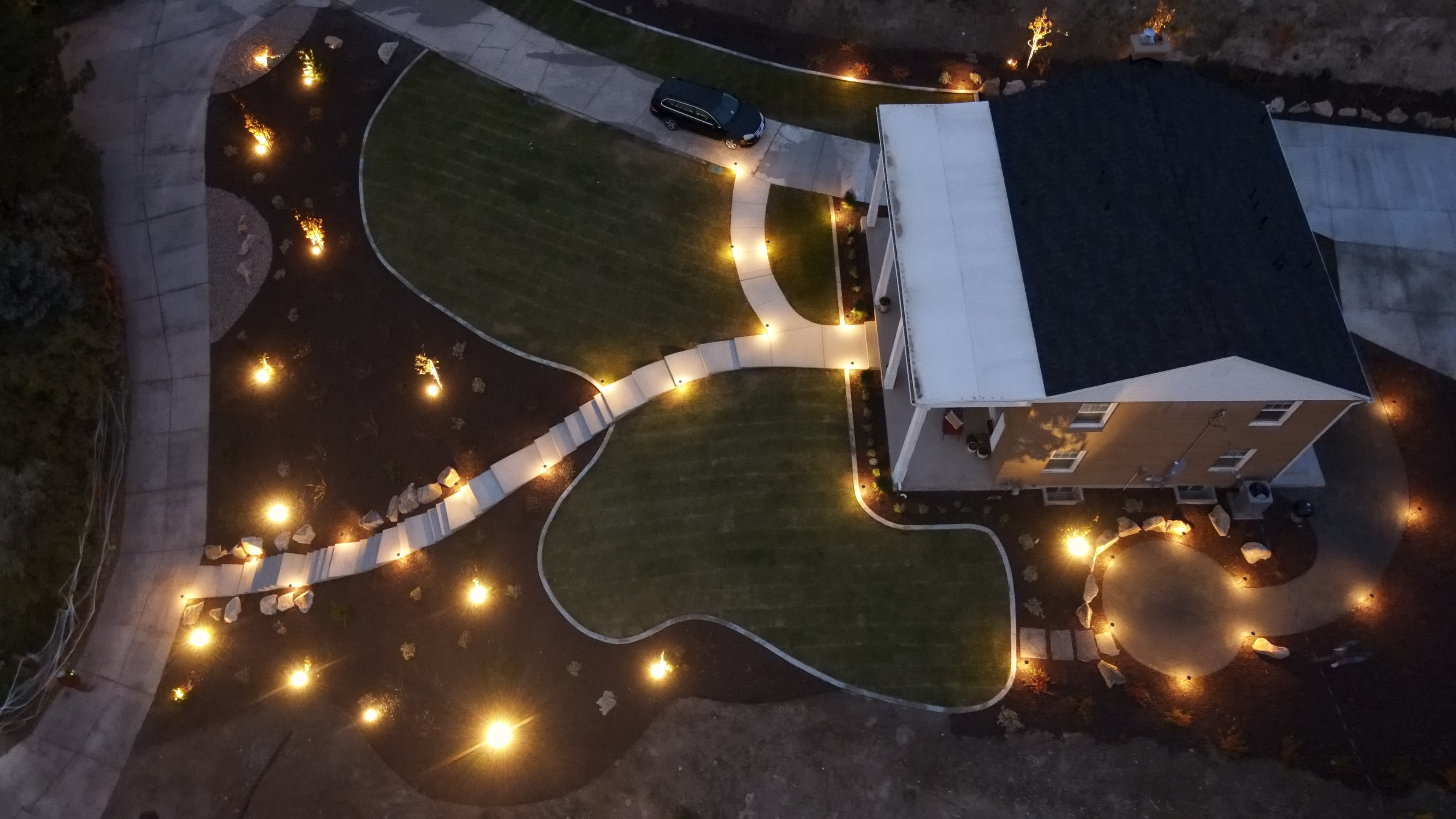
Lighting as part of the complete landscape
Landscape lighting is often treated as a finishing detail — something added after the hardscapes, planting, and irrigation are complete. In practice, it is a design discipline that affects how a property reads after dark, how outdoor spaces are used, and how the architecture and landscape relate to one another at night.
A lighting system planned from the beginning of a project can be integrated into the hardscape layout, the planting design, and the electrical infrastructure. A system added at the end has to work around decisions that were already made without it.
Architectural lighting
Architectural lighting reveals the form of a building at night. Uplighting placed at the base of a wall or column draws attention to texture, height, and material. Grazing light across a stone or stucco surface creates depth that flat floodlighting cannot produce.
The goal is not to illuminate the building uniformly. It is to select the features worth emphasizing and light them in a way that reads as intentional rather than functional.
Trees and planting
Mature trees are among the most effective elements to light in a landscape. Uplighting placed at the base of a significant tree creates a focal point that anchors the composition at night. The canopy becomes visible. The trunk and branch structure become part of the nighttime environment.
Smaller ornamental trees, shrubs, and planting beds can be lit with lower-output fixtures that define the edges of a space without competing with the primary focal points.
Paths, steps, and grade changes
Path lighting serves a safety function, but it also defines the edges of a space and guides movement through the landscape. Fixtures placed too close together, too bright, or at inconsistent heights create a runway effect that reads as institutional rather than residential.
Steps and grade changes require particular attention. A step that is not clearly visible at night is a hazard. Lighting integrated into the riser or placed at the side of the step addresses the safety requirement without creating glare.
Retaining walls and hardscapes
Retaining walls, paver patios, and concrete flatwork can be lit in ways that emphasize their texture and geometry. Grazing light across a segmental retaining wall reveals the coursing and shadow lines that make the material interesting. Downlighting from a nearby structure or tree can wash a patio surface with soft, even light.
Hardscape lighting works best when it is planned alongside the hardscape design — not added afterward with surface-mounted fixtures that were not part of the original layout.
Outdoor-living and entertainment areas
Outdoor kitchens, pergolas, fire features, and gathering areas require lighting that supports the way the space is used. Task lighting over a cooking surface. Ambient light at a comfortable level for conversation. Accent lighting that defines the perimeter of the space without creating glare.
The challenge is balancing function with atmosphere. A space that is too bright loses the quality that makes outdoor living appealing at night. A space that is too dim is uncomfortable and difficult to use.
Fixture placement and glare control
Glare is the most common problem in residential landscape lighting. A fixture aimed directly at eye level, or a lamp that is too bright for its application, creates discomfort and reduces the visibility of everything around it.
Glare is controlled through fixture selection, aiming angle, and output level. Shielded fixtures, buried uplights, and fixtures with appropriate beam spreads for their application all reduce glare while maintaining the intended effect.
Warmth, intensity, and visual balance
Color temperature affects how a landscape reads at night. Warmer light — in the 2700K to 3000K range — tends to read as residential and inviting. Cooler light can appear clinical in a residential setting.
Intensity balance matters as much as individual fixture output. A single bright fixture in an otherwise dark landscape draws the eye and creates an imbalance. A well-designed system distributes light in a way that reads as coherent — with focal points, transitions, and areas of intentional shadow.
System planning and future expansion
A low-voltage landscape lighting system should be designed with capacity for future additions. Transformers sized too tightly for the initial installation leave no room for expansion. Conduit runs placed during hardscape construction allow future wiring without cutting through finished surfaces.
Smart controls — timers, dimmers, zone switching — add flexibility without requiring additional fixtures. A system that can be adjusted seasonally or for different uses is more useful than one that operates at a single fixed output.
Common lighting-design mistakes
The most common mistakes in residential landscape lighting are using too many fixtures, selecting fixtures that are too bright, placing fixtures without a clear compositional intent, and treating lighting as an afterthought rather than a design element.
More fixtures do not produce a better result. A smaller number of well-placed, appropriately sized fixtures produces a more refined and more useful lighting environment than a large number of fixtures installed without a clear plan.
Discuss Your Landscape Lighting Project
Tell us about your property, the areas you want to illuminate, and the way you use the space after dark. Our team will review the information and identify the appropriate next step.