
The direct answer
Yes. Any deck surface exposed to direct Utah summer sun will become hot — composite, Advanced PVC, wood, or concrete. This is not a defect or a product failure; it is a physics reality. A dark surface absorbs solar energy and radiates it as heat. The question is how much, and what you can do about it.
Utah's high-altitude sun is intense. At 4,500 feet in the Salt Lake Valley, UV exposure is meaningfully higher than at sea level, and summer afternoon temperatures on a south-facing deck can be significant regardless of what the surface is made of.
Color matters more than material
Darker colors absorb more solar energy and generally become hotter than lighter ones. A deep espresso or charcoal board in full afternoon sun will be noticeably warmer underfoot than a light gray or warm tan board in the same conditions. This applies across both composite and Advanced PVC products.
That does not mean darker colors are wrong. A darker board under a pergola or shade structure may be perfectly comfortable. A darker board on a north-facing deck that receives limited direct sun may perform similarly to a lighter board in full sun. Color selection and shade planning work together.
Physical samples are essential for this decision. The way a color reads on a screen is not the same as how it reads in Utah afternoon light. We have Trex and TimberTech samples at our Murray location.
SunComfortable™ technology
Trex Transcend Lineage carries SunComfortable™ designation across all seven colors. This reflects Trex's heat-mitigating technology, which is designed to reduce heat buildup compared to earlier Trex board formulations.
Trex itself qualifies SunComfortable™ with the note that even these boards can become hot in direct sunlight, and darker colors generally become hotter. We apply the same qualification whenever we discuss heat performance. SunComfortable™ is a meaningful improvement — it is not a claim that the deck stays cool.
SunComfortable™ designation is collection-specific and color-specific. Not all Trex colors carry it. Three of the five Transcend colors carry it. Three of the six Select colors carry it. Two of the four Enhance Basics colors carry it. The color cards on our Composite Decking page show the badge where it applies.
TimberTech heat performance
TimberTech publishes heat-performance data for certain Advanced PVC collections under its own test methodology. That data reflects a specific test framework and comparison baseline — it is not a direct comparison to any named competitor product.
We do not publish a brand temperature winner. Both manufacturers offer products intended to reduce heat buildup, but their public performance claims come from different products, colors, test methods, and comparison baselines. Applying a headline number from one manufacturer's test to a different manufacturer's product produces a comparison that was never actually made.
Shade and orientation
A pergola, shade sail, or covered structure over part of the deck changes the heat experience significantly. East-facing decks that receive morning sun but are shaded by afternoon are generally more comfortable than west-facing decks that absorb peak afternoon heat.
If heat comfort is a priority for your project, we discuss color selection, shade structure options, and material choices together — not as separate decisions. A darker board under a pergola may be the right answer. A lighter board on an open south-facing deck may be the right answer. The combination matters.
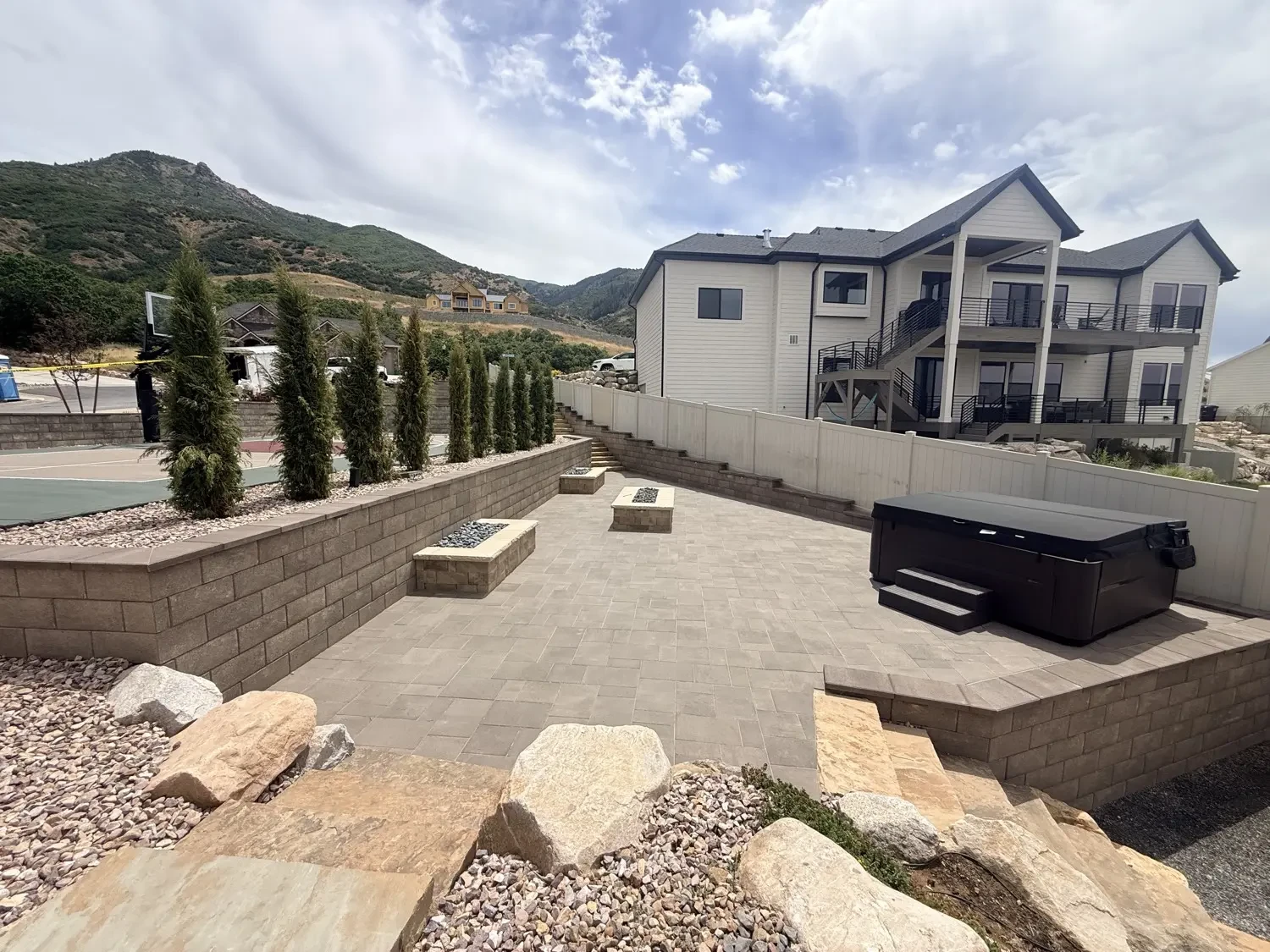
Our Layton Sport Court & Outdoor Living project used Trex Transcend Lineage Carmel — a warm mid-tone that balances heat performance with the aesthetic of the overall outdoor-living design.
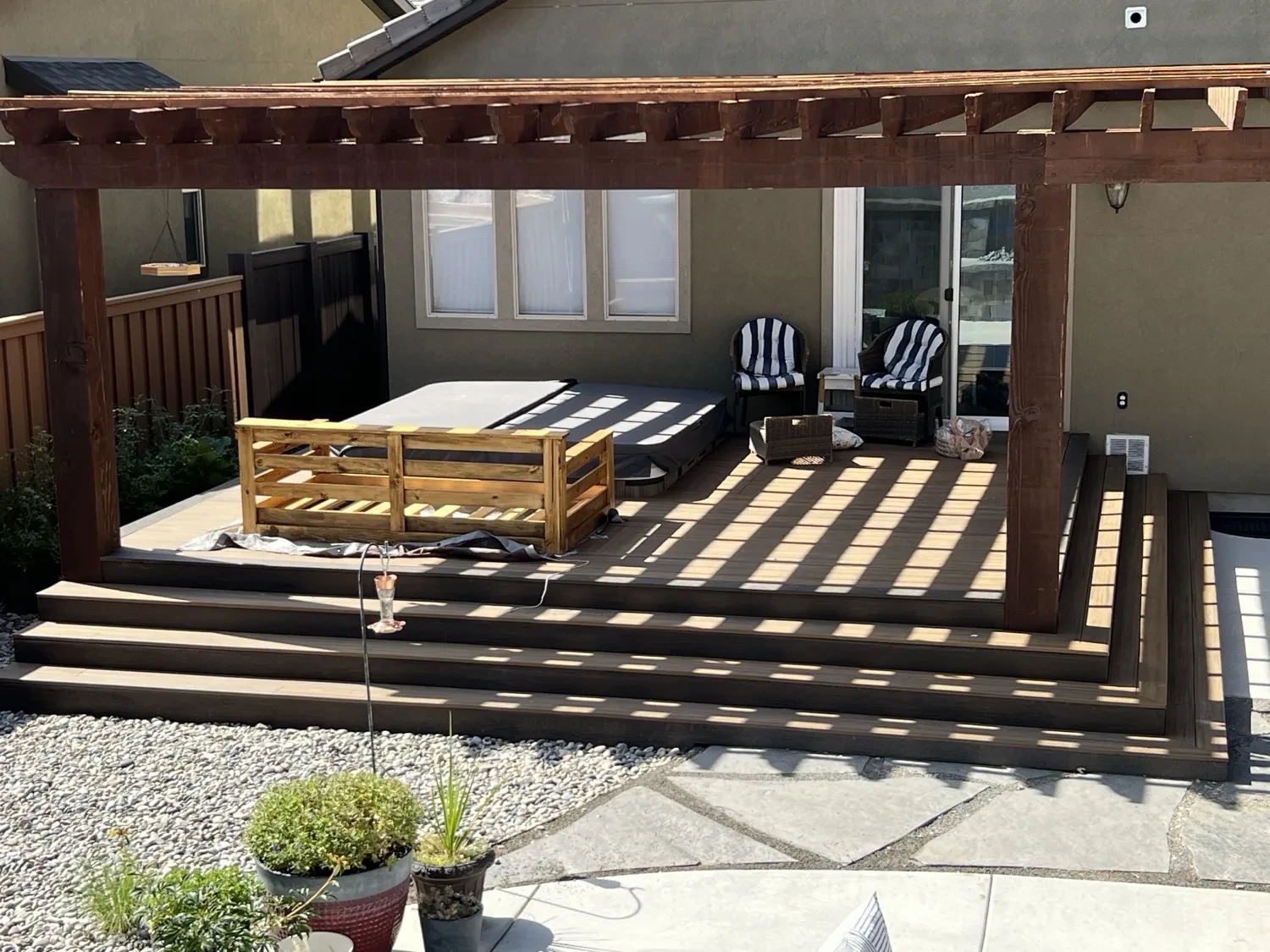
Installed example — Draper
Trex Transcend Havana Gold + Spiced Rum
A hillside outdoor-living project with a Trex composite deck under a cedar pergola. Two Transcend colors — Havana Gold for the field, Spiced Rum for stairs and border. The pergola provides afternoon shade over the primary seating area.
See the Draper projectPlan your deck before you call
The Deck Planner includes material preference and shade structure questions — so we arrive on site with context.