
Location
Daybreak, South Jordan, Utah
Scope
Trex Deck · Hot Tub · Concrete · Artificial Turf · Privacy Planting
Decking
Trex Island Mist composite
Railing
Black powder-coated metal railing
Project overview
A Compact Daybreak Lot Transformed into a Multi-Zone Outdoor Living Space
The Daybreak project started with a compact backyard that needed to do a lot of work — deck, hot tub, outdoor gathering space, and privacy — without feeling crowded. The design separates the space into distinct zones connected by a clear circulation path.
An elevated Trex composite deck with hot-tub integration anchors the upper zone. A custom concrete courtyard with artificial turf bands anchors the lower zone. Privacy trees along the rear property line complete the enclosure.
Trex Deck & Hot Tub
Elevated Trex Composite Deck with Hot-Tub Integration
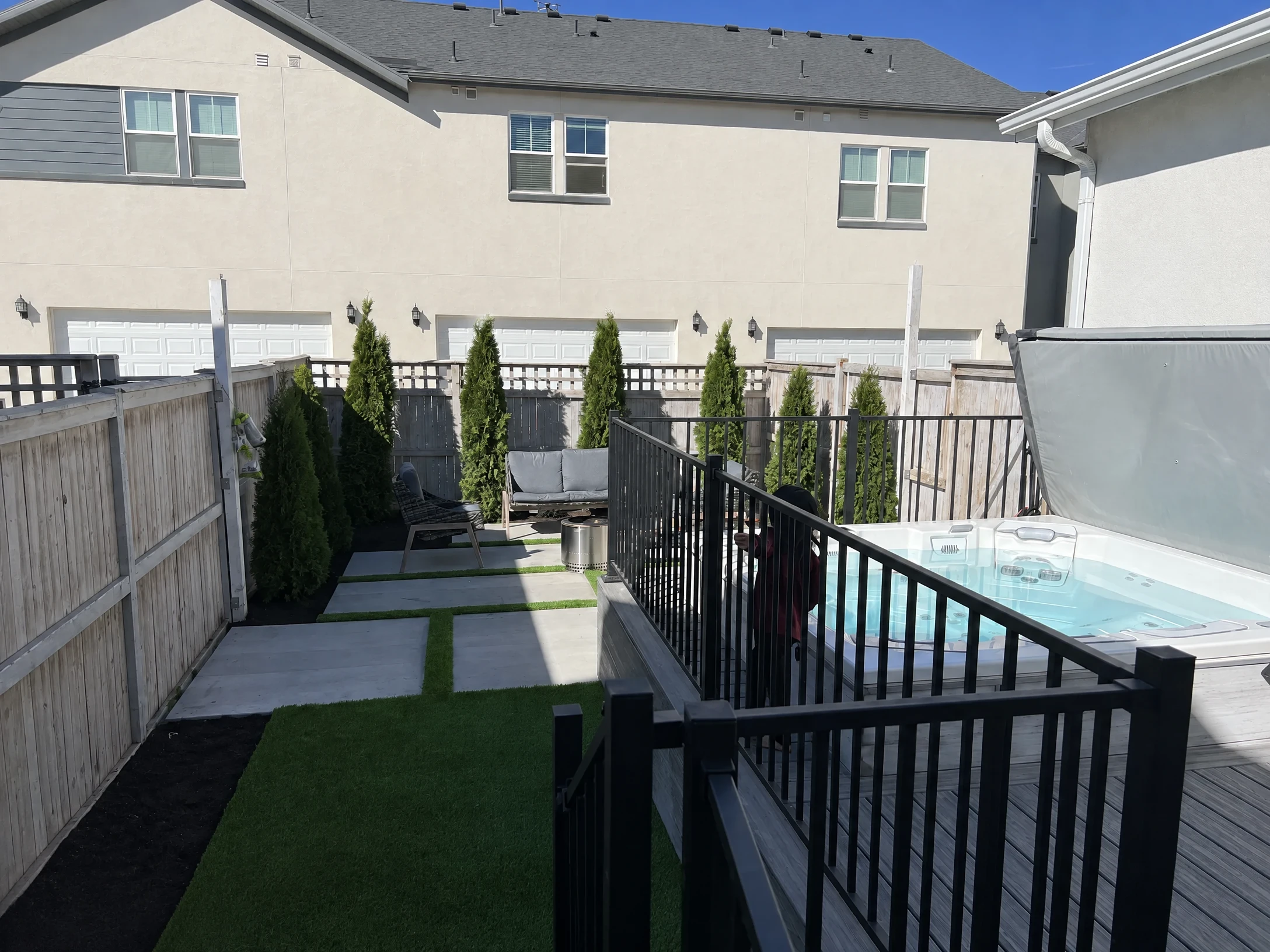
The deck uses Trex Island Mist composite decking with black powder-coated railing. The hot tub sits flush with the deck surface for a clean, integrated appearance.
A stair-and-gate assembly connects the deck to the lower courtyard, creating a defined entry point between the two zones while maintaining visual openness across the yard.

Concrete Courtyard
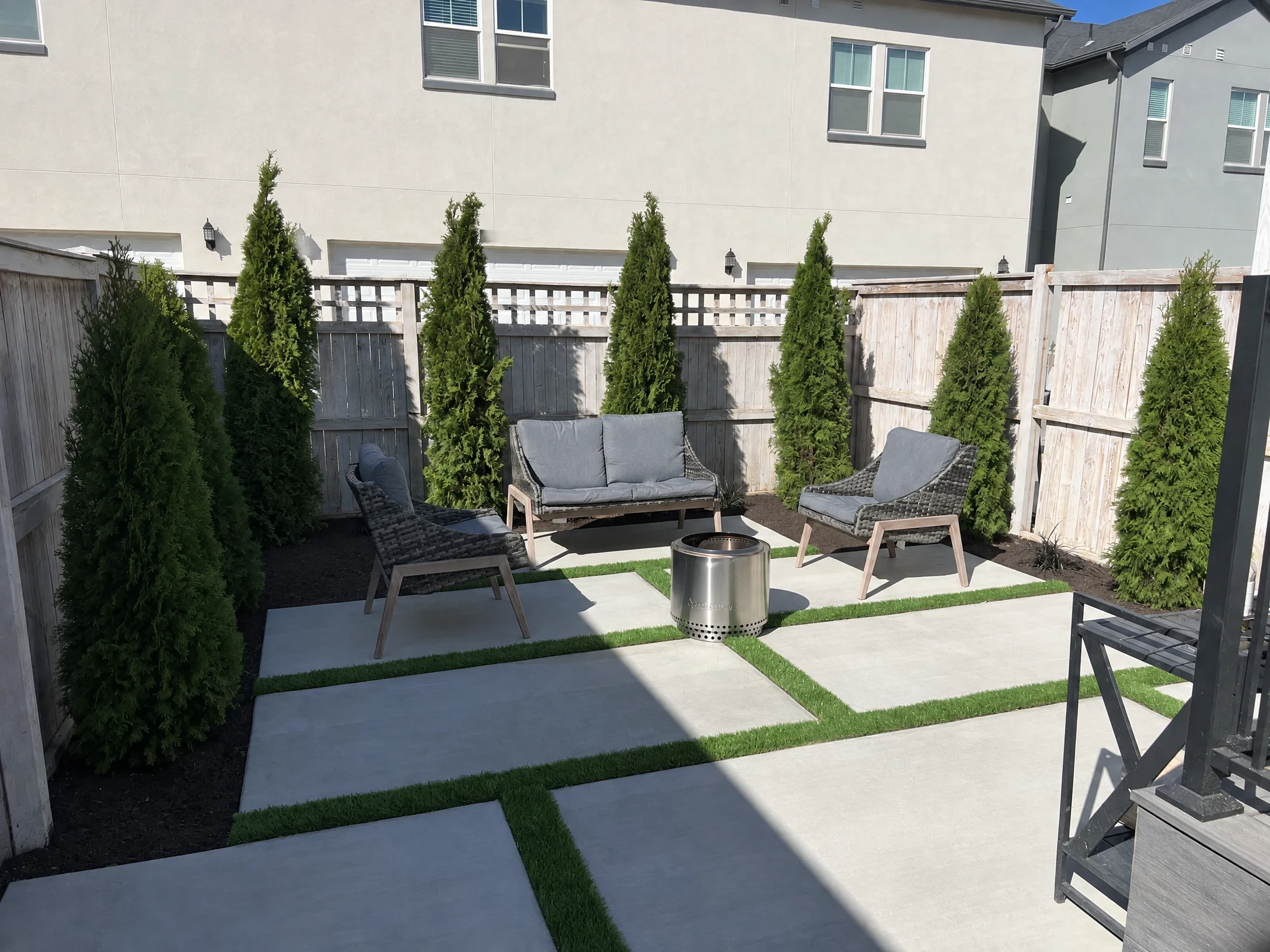
Custom Concrete Courtyard with Artificial Turf Bands
The lower courtyard anchors the backyard with a custom concrete slab and inset artificial turf bands — a low-maintenance surface that reads as a finished outdoor room rather than a utility area.
A freestanding fire feature is shown within the courtyard setting. It is not a Black Diamond-built fire feature.

Turf & Circulation
Practical Circulation Between Zones
Artificial turf fills the side yard corridor between the deck stairs and the courtyard, creating a soft, durable surface that handles foot traffic and drains cleanly.
The circulation path was designed to feel intentional — not a leftover gap — with consistent materials and a clear route between the upper deck and lower courtyard.

Privacy Planting
Privacy Trees for Year-Round Screening
A row of evergreen privacy trees along the rear property line provides year-round screening from neighbouring properties, creating a sense of enclosure without a solid fence.
The Finished Result
A Private, Multi-Zone Backyard on a Compact Daybreak Lot
The completed project delivers three distinct outdoor zones — an elevated deck with hot-tub integration, a custom concrete courtyard, and a planted privacy buffer — all connected by a clear circulation path and unified by consistent materials.
Common questions about this project
What composite decking was used on the Daybreak project?
The deck uses Trex Island Mist composite decking.
How is the hot tub integrated into the deck?
The hot tub sits flush with the deck surface for a clean, integrated appearance.
Another Daybreak project
Daybreak Water-Wise Front Yard Renovation
A different Daybreak property — front yard and side garden rebuilt with water-wise planting from Glover Nursery, a Belgard wall at the porch, rebuilt concrete entry steps, and a flagstone side path.
View the project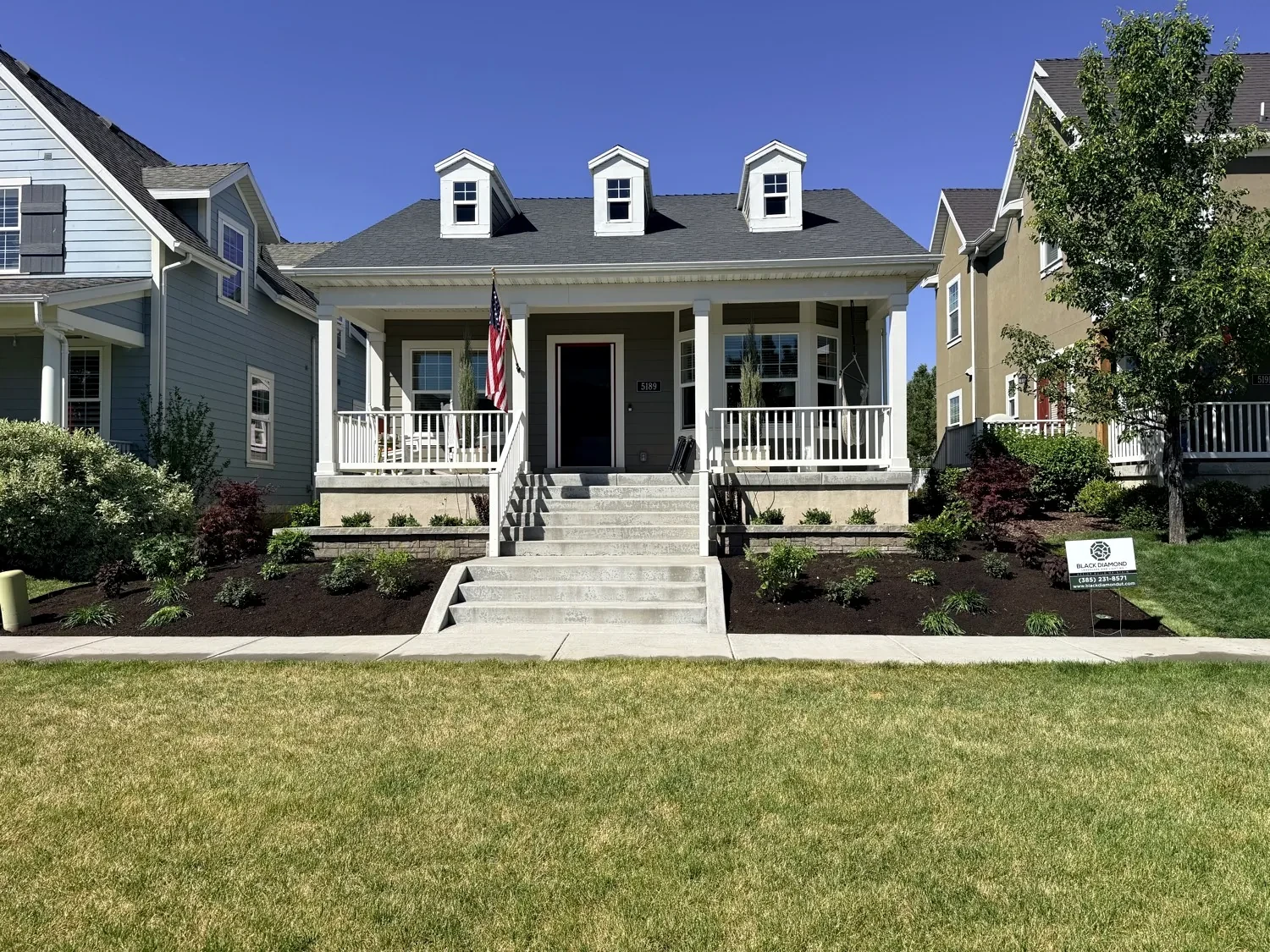
Trex Island Mist — deck detail
First-party photography from this Daybreak installation.


Decking material
This project features Trex Island Mist composite decking — a cool driftwood-toned board installed in a compact South Jordan deck and hot-tub setting.
Explore Trex Island Mist on our composite decking page →Planning a Backyard Transformation?
We work with compact lots and challenging layouts throughout the Salt Lake Valley. Contact us to discuss your project.
Serving the Greater Salt Lake Valley
Decking & Spa Questions — Daybreak
How we planned the Trex composite deck and flush-inset spa on this project.
Moisture resistance is one factor — but it is not the only one, and the surface board is not the whole story.
For applications immediately adjacent to a pool, hot tub, or water feature, a fully synthetic Advanced PVC product is worth evaluating. TimberTech Advanced PVC collections have no wood fiber, which means the board itself does not absorb water or support mold growth in the way a wood-composite product can. That said, the framing, drainage, flashing, and ventilation design matter just as much as the surface board for the long-term performance of the assembly.
Drainage planning matters from the start. Water that pools on the deck surface, collects against the house, or saturates the framing creates problems regardless of what the boards are made of. We design the drainage and framing as part of the deck scope — not as an afterthought.
Our Daybreak South Jordan project shows a Trex composite deck with the hot tub integrated flush with the deck surface — the spa sits inset into the deck rather than placed on top of it. The deck uses Trex in Island Mist; the exact collection (Lineage or Transcend) remains under verification from the project record.
If you are planning a deck around a hot tub or pool, the Deck Planner includes a spa/pool question that helps us understand the scope before we meet on site.
The surface board is not the structural design for the spa load. A filled hot tub can weigh several thousand pounds — the framing, beams, footings, and foundation design must safely carry that concentrated weight, and that design is determined by the structural requirements of the spa, not by which decking product is chosen.
Black Diamond plans the spa and deck structure together. We do not treat the hot tub as an accessory added after the structure is designed. The framing layout, beam sizing, footing placement, and connection to the house or freestanding structure are all part of the initial design scope.
If you are planning a deck with a hot tub, include that in the Deck Planner — it changes the structural scope and the planning conversation.
Composite decking combines polymer materials with wood-based content — typically reclaimed wood fiber and plastic. The wood fiber contributes to the board's natural appearance and texture, but it also means the material can respond to moisture and temperature differently than a fully synthetic product.
TimberTech Advanced PVC collections — Vintage, Landmark, and Harvest+ — use fully synthetic PVC construction with no wood fiber at all. That difference in composition affects how the board handles moisture exposure, how it behaves in wet or pool-adjacent applications, its weight, and how it responds to heat.
Neither material is universally better. The right choice depends on the specific project: the site conditions, the application, the aesthetic goals, and how the deck will be used. We evaluate both options on every project where decking is part of the scope.
Planning a deck around a spa? Read our hot tub & pool decking resource or compare composite vs. Advanced PVC.